Subfloor microclimates in Rapid City directly regulate the survival of structural pests. In neighborhoods along Rapid Creek such as Canyon Lake, Robbinsdale, and Valley Green, high water tables elevate subfloor…
Subfloor microclimates in Rapid City directly regulate the survival of structural pests. In neighborhoods along Rapid Creek such as Canyon Lake, Robbinsdale, and Valley Green, high water tables elevate subfloor relative humidity above 70 percent. This sustained moisture softens Douglas fir and ponderosa pine floor joists, creating the exact wood-fiber saturation levels required by subterranean termites and carpenter ants. In older sandstone-and-rubble foundations across the West Boulevard Historic District and North Rapid, moisture wicks upward through mortar joints, facilitating fungal decay (Coniophora puteana) that degrades lumber tensile strength and attracts wood-boring beetles. Rural acreage in Colonial Pine Hills, Red Rocks, and Skyline Pines faces compounding subterranean pressure, where granitic rock outcroppings channel Black Hills snowmelt directly beneath crawlspace perimeters, drawing deer mice and camel crickets into exposed fiber insulation.
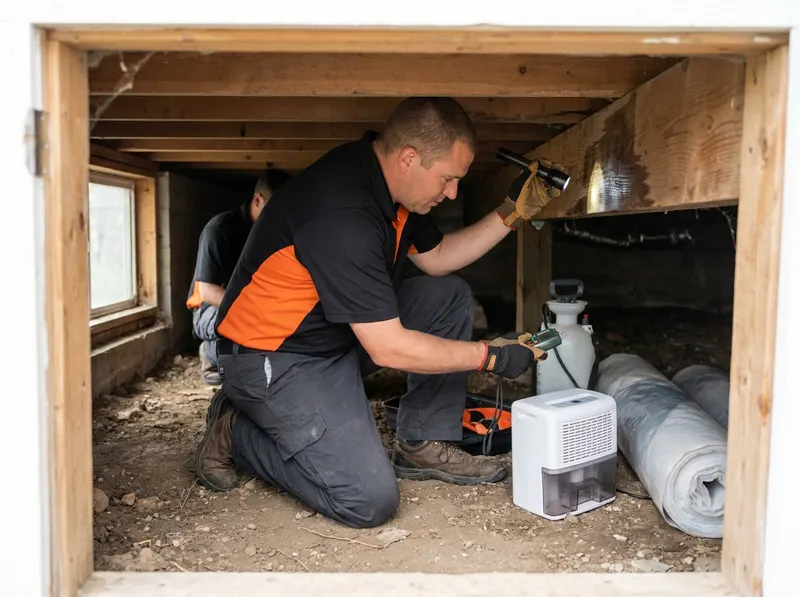
Crawlspace and subfloor moisture-pest mitigation operates on a two-phase standard of ecological exclusion and environmental regulation. Rather than repeatedly discharging chemical sprays into damp voids, which dilute and fail against continuous moisture, the protocol establishes closed-system humidity suppression. Technicians seal bare earth using 12-mil to 20-mil continuous polyethylene ground barriers, tape all seams against Radon and water-vapor transmission, and install heavy-duty foundation vent closures. Wood framing elements, including rim joists, sill plates, and subfloor sheathing, receive direct applications of disodium octaborate tetrahydrate (DOT). This mineral salt penetrates up to 0.75 inches into dimensional timber, permanently immunizing wood against dry rot, subterranean termites, and wood-boring beetles while remaining non-volatile inside the home envelope.
Selecting crawlspace and subfloor moisture-pest mitigation depends on structural parameters. If subfloor timber displays moisture content readings consistently above 18 percent on a calibrated pin meter, targeted topical bug spraying is ineffective; complete subfloor moisture mitigation is the required baseline. For homes in South Park and Wildwood built on monolithic poured slabs, exterior chemical barrier trenches suffice. However, for post-and-beam, stem-wall, or pier foundations, encapsulation and borate impregnation represent the only permanent barrier. The engineering trade-off balances initial capital outlay against structural longevity: encapsulation requires an upfront financial allocation for vapor-barrier materials and crawlway debris removal, yet it permanently halts foundation fungal rot, lowers seasonal indoor relative humidity by 15 to 25 percent, and eliminates the damp environments required by invasive pests.
Every job gets a firm, written price after a free on-site visit.
Tell us about your crawlspace and subfloor moisture-pest mitigation job in Rapid City and we'll send a clear, written quote, usually the same day.
 Denvirox Pest Management