Overwintering boxelder bug and beetle suppression addresses the behavioral biology of sun-seeking perimeter pests common to the Black Hills foothills. When autumn daytime ambient temperatures drop below 60 degrees…
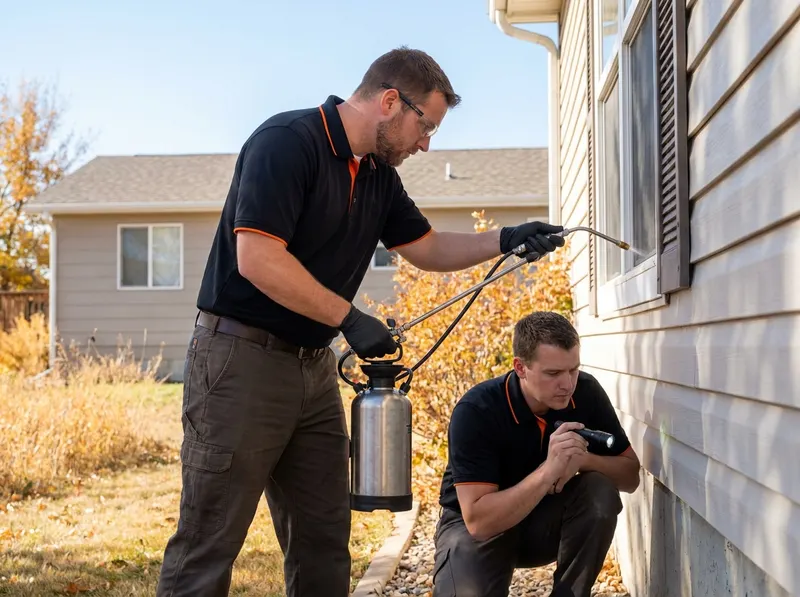
Overwintering boxelder bug and beetle suppression addresses the behavioral biology of sun-seeking perimeter pests common to the Black Hills foothills. When autumn daytime ambient temperatures drop below 60 degrees Fahrenheit, western boxelder bugs, elm seed beetles, and multi-colored Asian lady beetles mass on southern and western structural facades to absorb residual solar heat. Unchecked clusters slip behind siding, around utility conduits, and through microscopic window frame gaps, entering structural insulation where they remain dormant until winter warm spells prompt them to emerge inside living areas. In Rapid City neighborhoods with mature deciduous canopies, such as West Boulevard Historic District, Canyon Lake, Robbinsdale, and South Park, heavy female boxelder trees (Acer negundo) and Siberian elms generate massive populations that converge on nearby residences each September and October.
Effective containment requires timing intervention prior to deep wall penetration. Liquid residual micro-encapsulated formulations applied to exterior masonry, lap siding, fascia boards, and sun-exposed rooflines establish a chemical barrier that neutralizes active crawlers before entry points can be accessed. Properties backing into ponderosa pine transitions and open foothills, including Skyline Pines, Wildwood, Red Rocks, and Colonial Pine Hills, experience compounding pressure from both boxelder bugs and invasive elm seed beetles seeking shelter against fluctuating foothill winds. A targeted exterior perimeter suppression protocol serves structures exhibiting annual fall swarm activity; in contrast, interior-only aerosol sprays fail to solve the core infestation because they merely kill the small percentage of insects that have already penetrated wall voids.
Executing exclusion work requires clear procedural steps to ensure perimeter integrity: 1. A physical linear inspection identifies structural gaps greater than 1/8 inch along foundations, window assemblies, and plumbing penetrations. 2. A targeted application of micro-encapsulated pyrethroid residual is administered up to three feet up the foundation wall and two feet out across the soil perimeter. 3. High-reach equipment applies residual barriers to sunny second-story eaves, window perimeters, and chimney flashing seams. 4. Polyurethane sealants or copper mesh are applied to seal obvious mechanical entry points around wire bundles and vent pipes. 5. Follow-up evaluations verify that outer insect congregating clusters have ceased movement, preventing the persistent scratching and wall-void buzzing sounds that plague property owners throughout winter.
Every job gets a firm, written price after a free on-site visit.
Tell us about your overwintering boxelder bug and beetle suppression job in Rapid City and we'll send a clear, written quote, usually the same day.
 Denvirox Pest Management