Rodent mechanical exclusion provides architectural defense against deer mice, Norway rats, and bushy-tailed woodrats (pack rats) native to the Black Hills transition zone. Standard chemical baits leave carcasses inside…
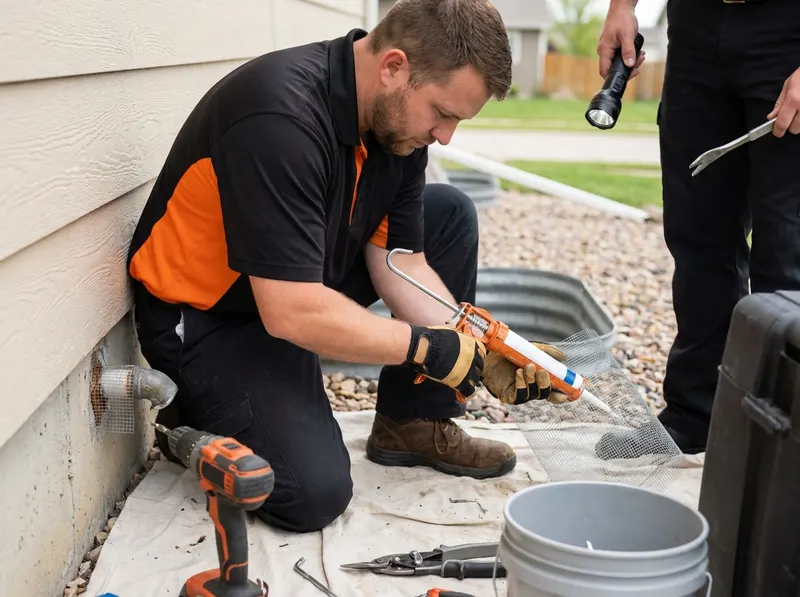
Rodent mechanical exclusion provides architectural defense against deer mice, Norway rats, and bushy-tailed woodrats (pack rats) native to the Black Hills transition zone. Standard chemical baits leave carcasses inside drywalls and fail to address recurring drafts, while exclusion physically seals the building envelope. Mice require an opening of only 0.25 inches to enter, while adult rats penetrate gaps measuring 0.5 inches. Properties bordering timbered corridors, such as hillside framing along Skyline Pines, foothill acreage in Colonial Pine Hills, and the Ponderosa transitions of Red Rocks, experience heavy seasonal rodent pressure during early autumn freezes. Similarly, stone-and-mortar foundations along the West Boulevard Historic District develop masonry voids that require structural mortar repairs combined with metal reinforcement. In lower-elevation corridors near Canyon Lake, Wildwood, and Valley Green, irrigation ditches and seasonal runoff channels funnel field rodents toward perimeter crawl spaces and subfloor vents.
1. Structural diagnostic: A field technician conducts a full-envelope transit of the structure, mapping weep screeds, crawl space vents, roof transitions, and utility penetrations.
2. Material barrier installation: Technicians anchor heavy-gauge steel flashing around AC line-set chaseways, secure 0.25-inch galvanized wire across soffit vents, and embed non-shrink composite mortar into stone voids.
3. Internal depressurization check: Entry zones around pipe chases are packed with stainless steel mesh and sealed with elastomeric compounds to stop thermal drafts that attract foraging rodents.
Mechanical exclusion fits residential structures experiencing active wall scratching, attic nesting, or chronic food pantry contamination where traps deliver only temporary relief. Chemical programs require perpetual bait replenishment, whereas structural exclusion establishes a permanent barrier. The engineering trade-off is higher upfront capital expenditure and installation time in exchange for long-term structural defense that eliminates secondary poison risks to local raptors. The baseline investment begins at the $300 minimum charge, reflecting basic utility sealing, while multi-level structures with complex roof junctures demand proportional material volume and installation labor.
Every job gets a firm, written price after a free on-site visit.
Tell us about your rodent mechanical exclusion job in Rapid City and we'll send a clear, written quote, usually the same day.
 Denvirox Pest Management